
A press starts with an understanding of the process.
For C&R, designing a hydraulic press means starting from what the machine has to do and the results the customer wants to achieve. Force selection and sizing come later.
Every project starts with an analysis of the application: materials, dies, operations, production cycles, required performance and operating conditions. This information is the basis for a technical solution consistent with the process.
Technology serving the production process
Closing force, platen dimensions, daylight, strokes, speeds, ejection systems, blank holder, power and working pressure are elements that must work together.
C&R sizes and integrates them according to the application, to achieve a press that is efficient, reliable and suited to actual production requirements.
The goal is not simply to build a more powerful machine, but a machine that delivers exactly the performance required, avoiding unnecessary oversizing while leaving the flexibility needed to meet future requirements.
C&R design also takes into account everything that determines the quality of day-to-day use: component reliability, safety, ergonomics, maintenance and ease of operation.
Every technical choice therefore has a precise reason and helps build a machine designed to integrate into the production process.
The right press is the one designed for you.
The key parameters of a hydraulic press
Closing force, strokes, speeds, ejection systems and blank holder: which parameters should be assessed when configuring a hydraulic press for a given production process?
Nominal force is certainly one of the main parameters, but on its own it is not enough to define the machine configuration.
No single parameter can define the ideal machine: force, stroke, dimensions, speeds, ejection systems and blank holder must be assessed as a whole and in relation to the dies and operations planned.
Added to these are maintenance, ergonomics, safety, component reliability and ease of use.
Closing force and return force
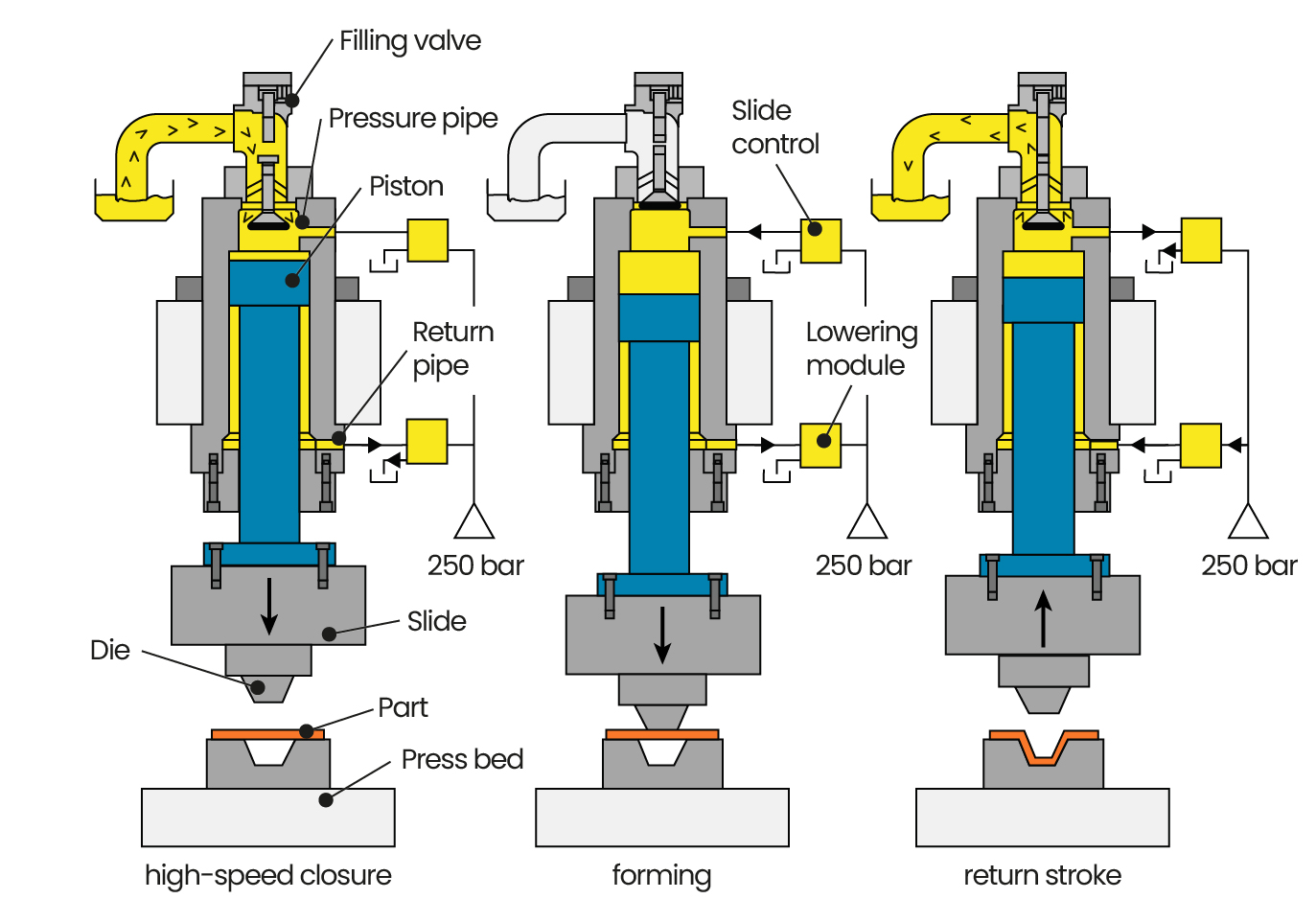
Closing force is one of the main parameters of a press and is expressed in kN. As a rule of thumb, 10 kN corresponds to roughly 1 tonne. The value is determined by the area of the upper cylinders and the working pressure.
The return force must also be sized for the specific application. It is generally taken as around 10% of the nominal force, but the trend is to relate it to production requirements, so as to optimise parameters such as rapid return speed.
The weight of the press’s moving parts must also be considered: slide, piston and accessories mounted on the slide. Assessing the available force net of these weights makes it possible to correctly determine the machine’s stripping capacity.
The nominal force can be achieved using a different number of cylinders, depending on requirements.
Stroke, daylight and platen dimensions
The slide stroke, expressed in mm, defines the useful working stroke.
Maximum daylight is the distance between the fixed lower bolster and the slide face at maximum opening. Minimum daylight, by contrast, is the distance between the fixed lower bolster and the slide face at minimum opening.
Both values, like the slide stroke, must be considered net of any operating overtravel.
The usable platen dimensions determine the area available for mounting the forming tools. Their sizing must take into account the largest die expected to be used.
The distance between the front and side uprights must also be assessed, as it determines the space available for passing dies, tooling and parts.
Ejection and blank holder
In processes involving ejection operations, the press configuration must include systems sized for the application.
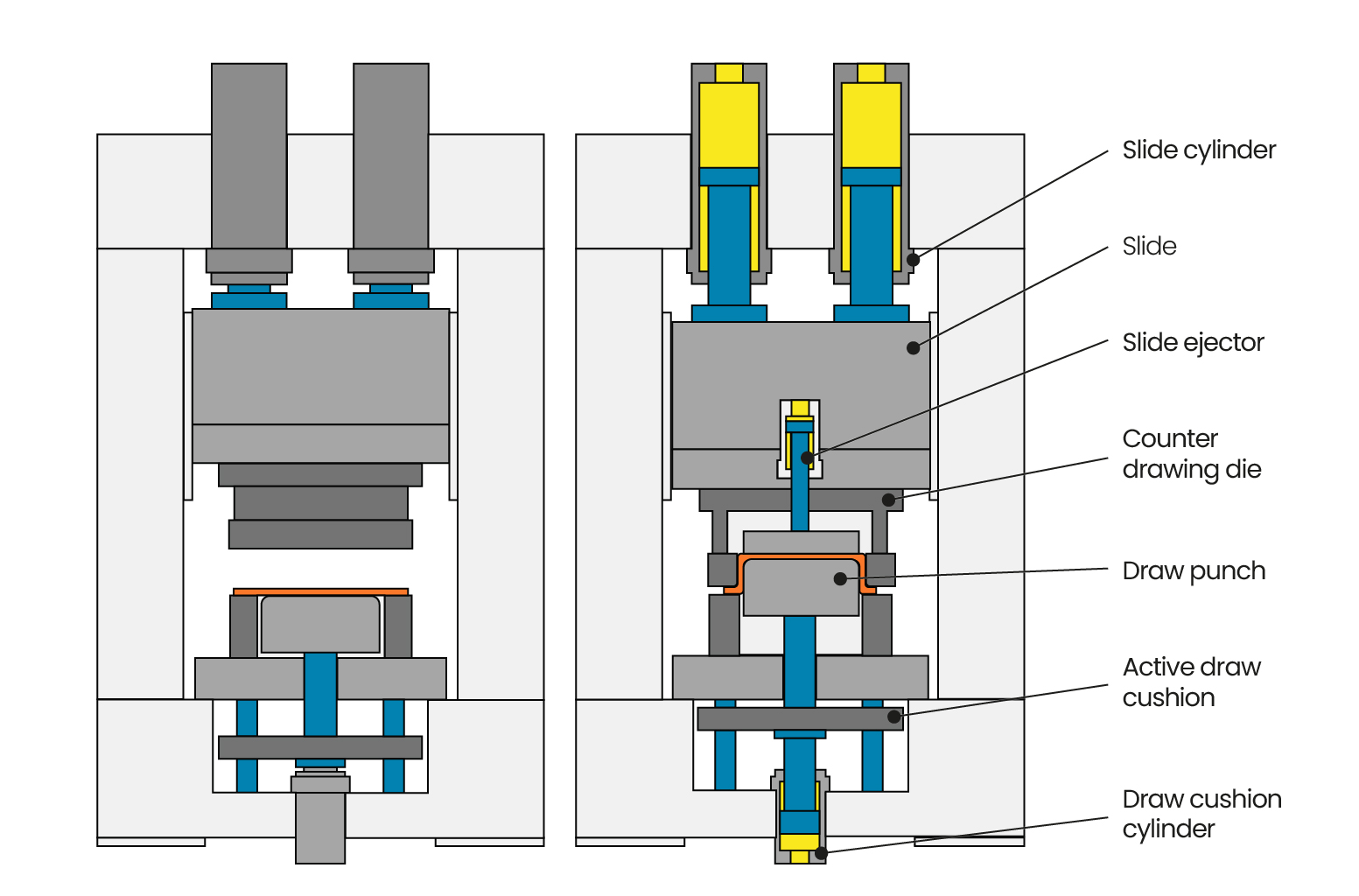
Ejection force is expressed in kN and depends on the area of the upper cylinders and the working pressure. A special case is the so-called third action, which can act as a passive upper blank holder or perform active upper drawing.
The system can use several cylinders, acting either directly or via an ejector plate. This configuration allows the ejector pins to be positioned according to the characteristics of the die.
The ejection stroke is expressed in mm and defines the useful working stroke of the ejector. This value must be net of any operating overtravel. It is usually equal to or less than the blank holder stroke.
The usable dimensions of the ejector plate are expressed in mm × mm and define the working area over which the ejector pins can act.
The role of the blank holder in deep drawing
Blank holder reaction force is a decisive parameter in deep drawing processes.
Expressed in kN, it is calculated by multiplying the area of the blank holder cylinders by the working pressure. As a rule, it equals 30% of the press’s nominal force for drawing carbon steels, and can rise to 50–70% for drawing stainless steels.
Design must take into account, in addition to the available force, the number of cylinders, the stroke and the usable dimensions of the cushion plate.
Power, pressure and speed
Installed power, expressed in kW, is the sum of the power used by the press. In technical documentation, it is useful to specify the motor power of the main pumps and the auxiliary pumps separately.
Working pressure indicates the maximum pressure at which the main cylinder operates. Although it is usually expressed in bar, the technical reference unit is the MPa: 1 bar corresponds to 0.1 MPa.
Operating speeds are another decisive factor. The press must combine travel speeds and forming speeds according to the characteristics of the cycle.
Rapid approach
The speed at which the slide descends as it approaches the die. It is generally between 300 and 1,000 mm/s.
Pressing or drawing speed
The speed at which deformation takes place during the working phase. It is normally between 3 and 250 mm/s and, for certain forming technologies, can also be adjusted during deformation.
Rapid return
The speed at which the slide rises back to its starting position; it ranges from 300 to 1,000 mm/s. When the cycle includes an ejection operation, it may be necessary to reduce the return speed.
These are joined by the blank holder return speed and the ejector speed, which must be sized according to the cycle and the characteristics of the process.
Footprint, foundations and geometry
When evaluating a press, dimensional aspects matter alongside performance: they are used to verify that the machine is compatible with the production environment.
Parameters to consider include:
- press base;
- height above floor level;
- working height;
- foundation dimensions;
- theoretical weight;
- dynamic load.
Working height also affects ergonomics, especially in applications with manual loading. The dynamic load, on the other hand, must be taken into account when designing the foundation, since it is the load acting on the supporting structure during operation.
Let's design a press for every production process, together
Every production requirement calls for a specific solution. That is why C&R offers its technical expertise and experience to analyse the process, identify the required characteristics and develop a hydraulic press designed around the customer’s actual needs.
For a new project, or to assess a solution for an existing line, we are available for an initial discussion about the application and to define the most suitable press.