
Structures, components, and molding types: what you need to know before delving into your choice.
Among the machines used for sheet metal processing, presses are the most varied in type, application and constructive design. They exist in a wide range of variants, subtypes and special configurations.
Single, double or triple-action presses in the hydraulic world; screw, eccentric and knuckle-joint presses in the mechanical one. A variety that reflects the technical response to the many demands of industrial production.
Hydraulic and mechanical presses share the same market, sheet metal and material forming, but operate according to profoundly different constructive principles. They are two tools in the same toolbox: each has its own application domain, where the other can rarely compete.
The choice between the two technologies depends on the nature of the part to be produced and on production volumes, not on price.
The five criteria that guide the choice
Choosing between a hydraulic and a mechanical press may seem like a purely technical question. It is not. It is a question about the production process: what is being produced, with what geometries, in what volumes, with what flexibility requirements. Answering these questions precisely is the most direct way to identify the right technology.
Here are the criteria that help determine which of the two technologies is the correct one for a given production requirement:
- Production speed (Stroke rate)
Hydraulic: speed is not the priority, precision of movement is, or the process requires dwell time (e.g. 10–30 strokes per minute).
Mechanical: produces millions of small or simple parts in reduced cycle times. Mechanical presses are extremely fast and can exceed 500 strokes per minute. - Forming depth (Stroke)
Hydraulic: excellent for deep drawing operations (e.g. a sink, a cylinder, a tall vessel). The hydraulic press can maintain full force throughout the entire stroke and the stroke length is theoretically unlimited.
Mechanical: primarily suited to shallow operations such as blanking, piercing or light bending. Some mechanical presses are equipped with linkage systems that allow medium-depth drawing. A mechanical press delivers its maximum force only when the slide is close to bottom dead centre. Stroke lengths are normally limited to approximately 1,000 mm. - Required force
Hydraulic: capable of applying very high force. Hydraulic presses can reach up to 100,000 metric tonnes.
Mechanical: force output within 6,000 metric tonnes. - Force control and precision
Hydraulic: the ideal choice when the material is delicate or the die is costly. If an obstruction occurs, the hydraulic press stops as soon as it reaches the preset pressure limit (pressure relief valve), protecting the die. It can also apply and hold pressure on a part for several seconds, and force and speed can be adjusted according to material type and process, whether deep drawing or blanking.
Mechanical: offers high precision on the final slide position, but carries a greater risk of component damage in the event of a malfunction, due to the inertia of the pressing movement. - Versatility and setup
Hydraulic: ideal for mixed production runs with frequent die changes. Pressure, speed and stroke can be adjusted with ease via software. A genuinely multitasking machine.
Mechanical: ideal for standardised production that rarely changes. Setup is more complex and rigid, but unmatched for extreme repeatability.
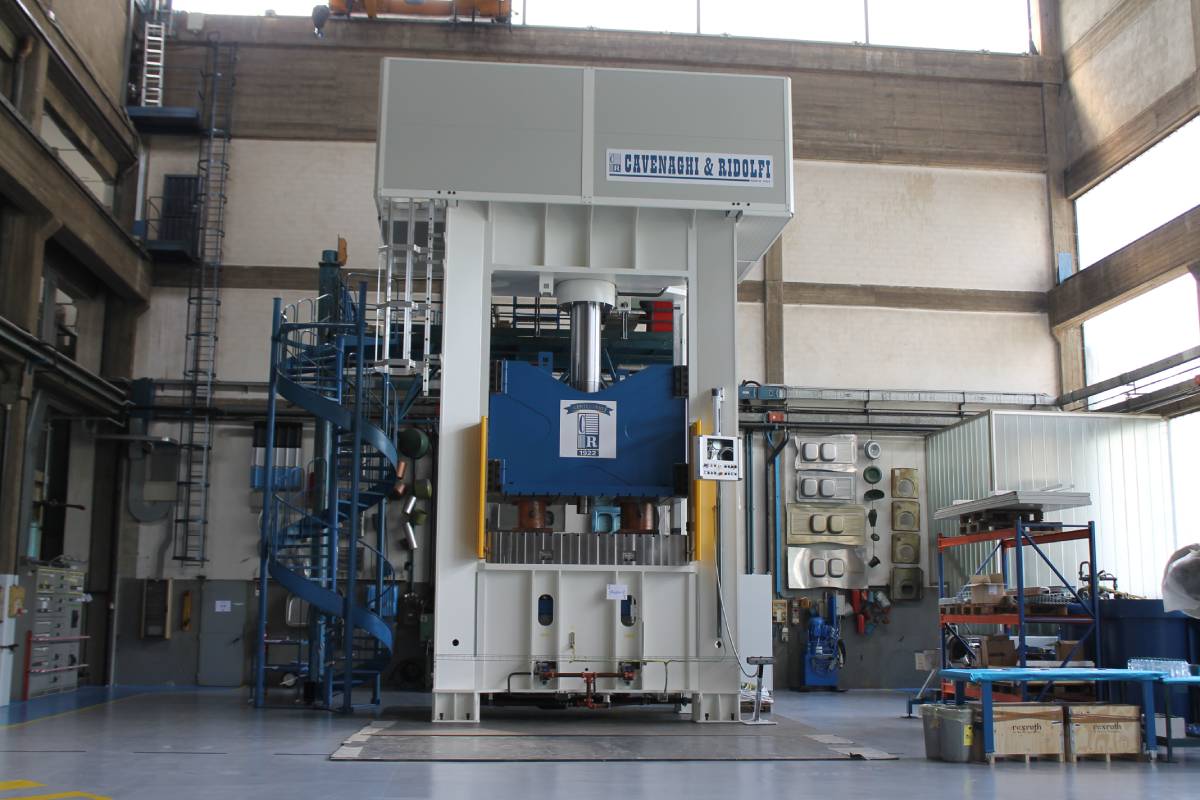
Pictured: special hydraulic press for manufacturing stainless steel sinks and components through deep drawing with active and passive bottom cushion effect.
- Nominal capacity: 6500 kN
- Stroke: 1500 mm
- Approach speed: 500 mm/s – Working speed: 56 mm/s
- Bolster plate dimensions: 2900×1700 mm
The comparison in summary
Taken together, the five criteria give a precise picture of the conditions in which each technology performs at its best. The table below sets them against each other directly:
| Characteristic | Hydraulic press | Mechanical press |
| Speed | Medium–low | Very high |
| Stroke | Theoretically unlimited | Up to 1,000 mm |
| Force | Up to 70,000 T | Up to 6,000 T |
| Force control | Constant throughout the stroke | Maximum at bottom dead centre only |
| Flexibility | High (adjustable parameters) | Low (fixed parameters) |
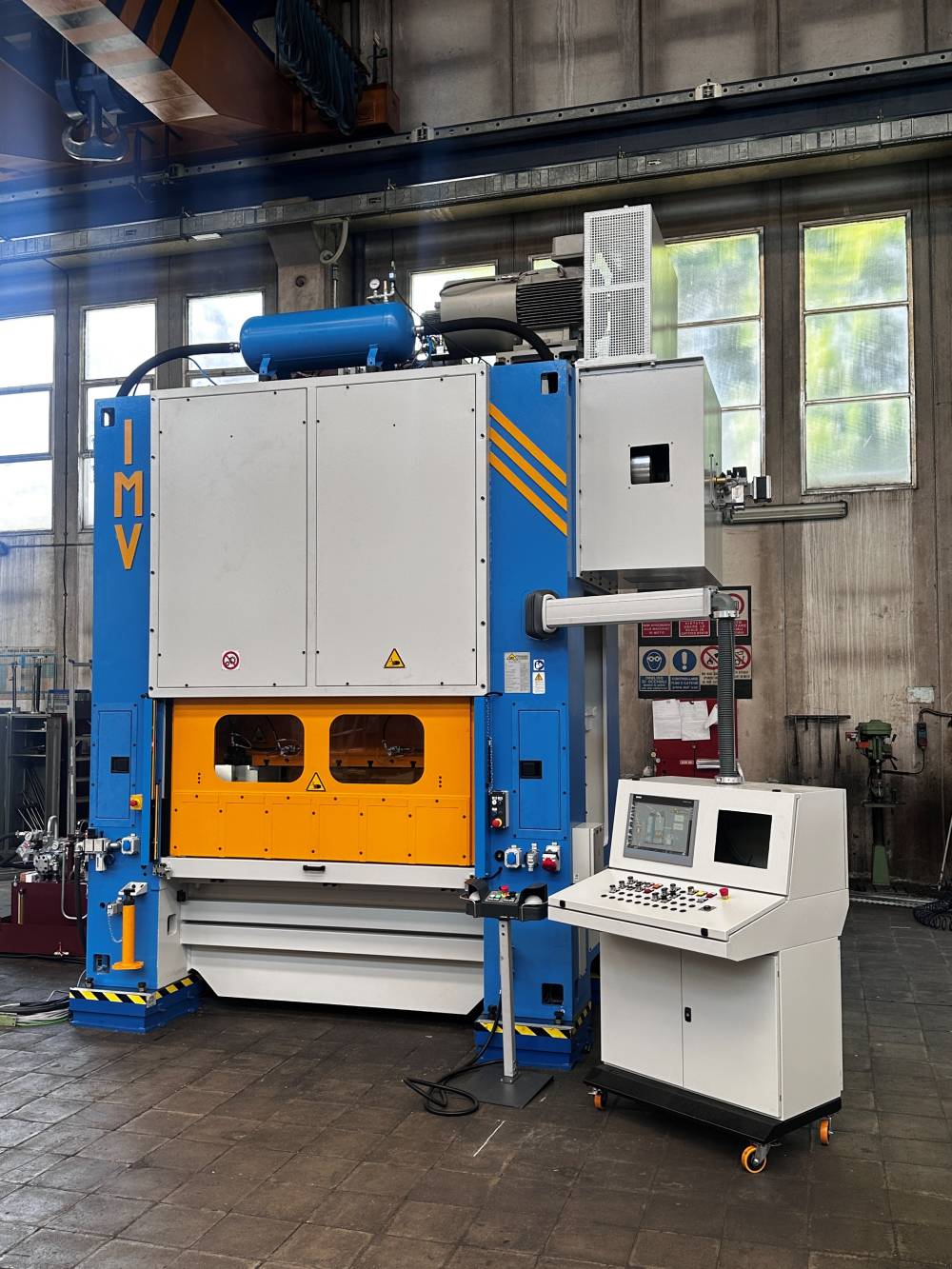
Pictured: high-precision mechanical press equipped with plunger guide system, preloaded roller guides, dynamic balancing of rotating masses, and epicyclic (planetary) gearbox.
- Nominal capacity: 2000 kN at 6.35 mm from bottom dead center (BDC)
- Stroke: 150 mm
- Speed: from 5 to 200 strokes per minute (spm)
- Bolster plate dimensions: 2000×100 mm
Every production has its own answer
The choice of technology is tied to the production context.
The hydraulic press is the answer when the part is complex or deep, when force must be distributed across the full stroke, or when production changes frequently. It is the right choice for those who prioritise quality and flexibility.
The mechanical press is the answer when the part is flat or shallow and volumes are high. It is the right choice for those who need pure productivity.
The two technologies are often complementary. A cookware production line, for example, may include a hydraulic press for deep drawing and a mechanical press for subsequent operations, two different machines, one single production logic.
There is no inherently superior technology. The right answer is always the one best suited to the production process at hand.
Hydraulic versus mechanical is, however, only part of the complete picture. Servo presses, in both their mechanical and hydraulic variants, add a further layer of possibilities, which we will explore in one of our upcoming issues.