
Structures, components, and molding types: what you need to know before delving into your choice.
The press is a machine designed to hold one or more molds, the moving parts of which are moved so as to be able to provide sufficient force to print or cut the material. In sheet metal processing machinery, hydraulic presses are used in industrial contexts where force, control, and repeatability are required. They are used in numerous production sectors because they allow for the management of even complex processes with precision, operational continuity and great adaptability.
Specifically, an oil press for molding uses the force of a fluid (typically hydraulic oil) to compress, shape, or cut materials, primarily metals or plastics, through the use of a mold. It can exert pressures ranging from a few tons to tens of thousands of tons.
The main components that make up a press are:
- Centralina Oleodinamica: the “motor” that pumps oil and generates pressure.
- Cylinders: transform the energy of the fluid into linear mechanical force.
- Mold: composed of a male part (punch) and a female part (matrix), determines the final shape of the piece.
- Control System: valves and sensors that regulate press speed, force and cycle time.
In practical terms:
- A pump sends high-pressure oil into a cylinder.
- Pressure pushes a piston that lowers the slide and closes the mold.
- The material placed between the two parts of the mold is deformed taking the desired shape.
The carefully soundproofed hydraulic equipment can be mounted on top of the presses or in the foundation when required. The electrical control equipment, enclosed in a standard cabinet, is generally installed separate from the press body. These presses are made with upper, lower, or a combination of both sheet metal pillows.
Oil dynamic presses must be designed and constructed in accordance with the Machinery Directive 2006-42-EC.
The versatility of this machine is concretely measured in the applications it is able to cover.
Most common types of molding
- Funneling: to create hollow shapes (such as cookware or appliance components).
- Tranching: to finish deep-drawn pieces.
- Forging: for hot metal forming.
- Molding thermoplastics and thermosets
The variety of applications also speaks to the variety of market demands: higher performance, faster cycles, more stringent security standards.
For this reason, hydraulic presses are fundamental elements in mass production both as single elements and integrated into production lines.
Production capacity depends on the performance of the press, the characteristics of the feed devices (two tightly bound systems), the mold and the devices for evacuating the parts and parts.
With this in mind, there are increasingly greater requests for automatic systems to simplify at most the various operations and reduce the adjustment and setup times. Considerable attention is also paid to the electronic control and synchronism systems of the elements that make up the line, and to the monitoring of the quantities critical to the operation of the system.
Understanding how a press is classified helps you navigate the available options and evaluate which configuration best meets your manufacturing needs. There are three main criteria:
- Structure type;
- Number of push points;
- Number of effects.
"O" structure or "C" structure: what changes under load
The geometric precision and structural stiffness of the machine depend on the type of structure. The machine structure, together with the guidance system, has the function of reacting to the deformation forces and of ensuring the correct mutual positioning of the mounted equipment between the worktops during the deformation phase of the workpiece.
Regardless of type and classification, it is essential that the structure be made with certified welding processes and undergo normalization and sandblasting treatment before machining.
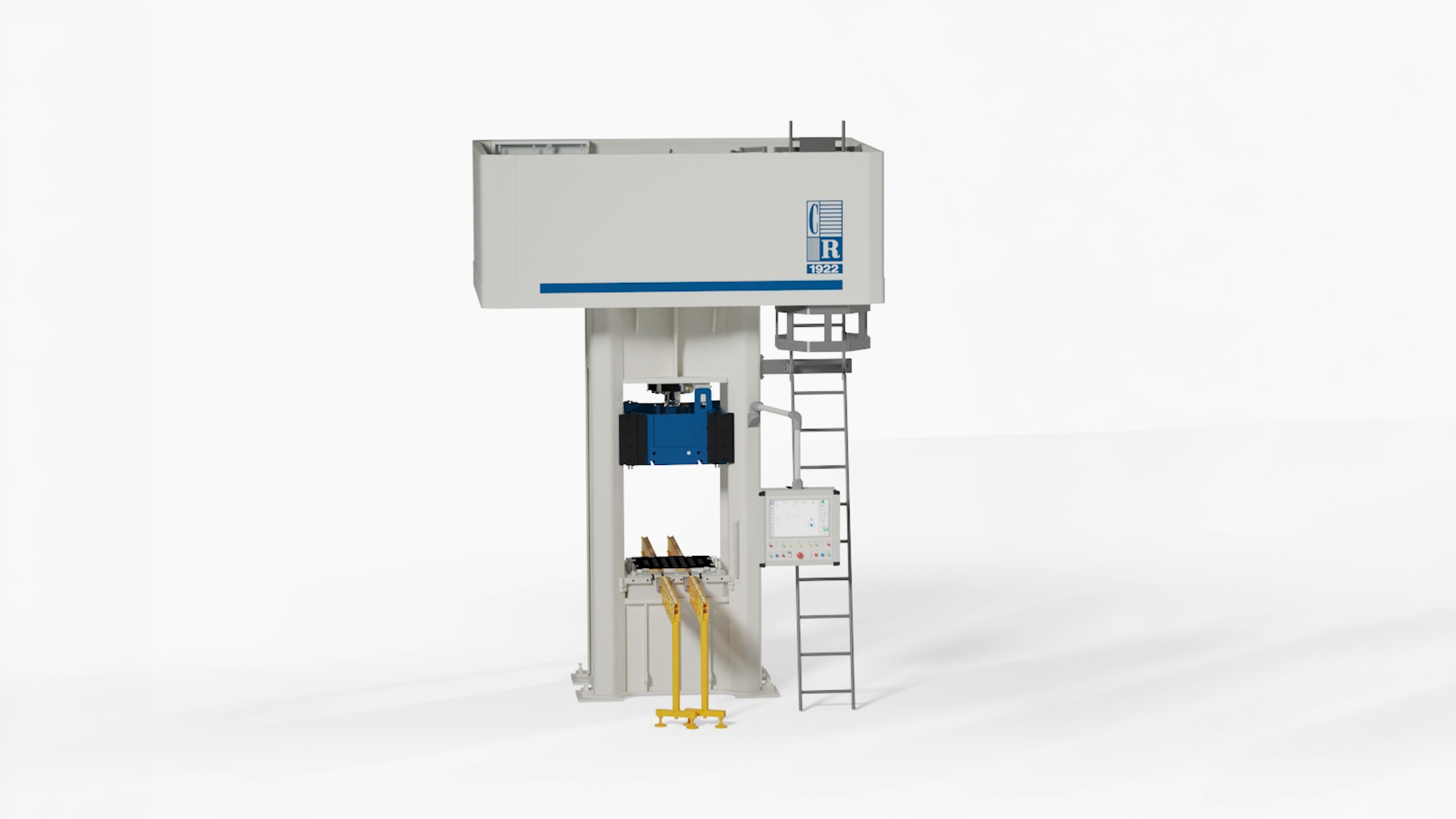
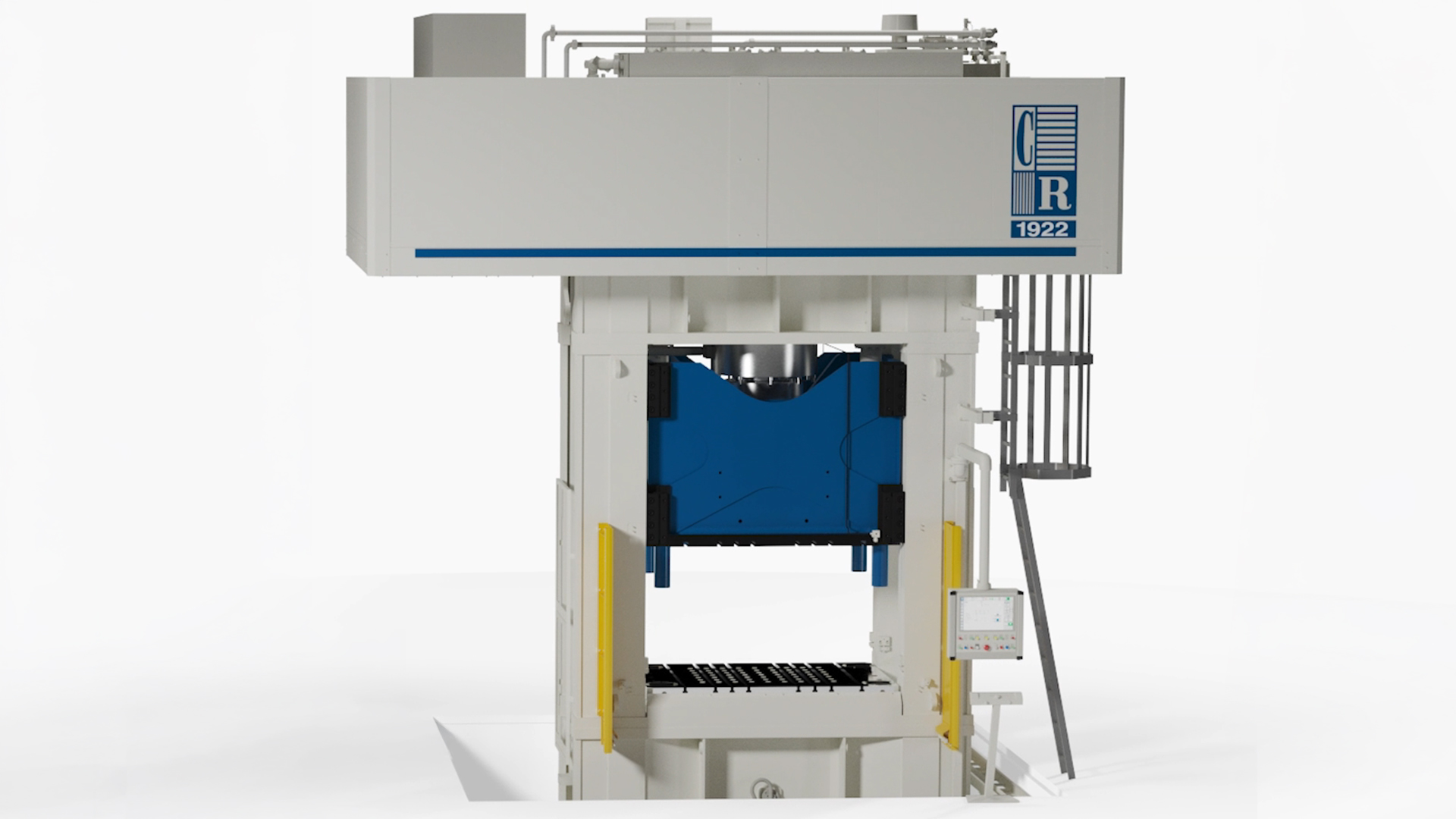
Double upright or "O" structure
This type of structure is characterized by a lower crosspiece, two or four uprights, an upper crosspiece. Under load, there is an elastic elongation deformation that keeps the working surfaces parallel and centered. A further classification divides this type of structure into the following two subtypes:
– Monolithic or monoblock. The lower crosspiece, the two or four uprights and the upper crosspiece are made with a one-piece welded structure. It is of considerable importance, in this type of structure, to create appropriate connecting spokes between the crosspieces and the uprights to ensure a long operating life for the structure itself. They are normally made in a force field between 600 and 30,000 kN. A distinctive feature of this series of presses is the extreme rigidity of the structure, the accurate eight-point slide guidance system with recordable larders. The limitations are essentially represented by the transportable dimensions and the spaces available for positioning the press in the workplace.
– Composed with tie rods. The lower crosspiece, the two or four uprights and the upper crosspiece are made with an electro-welded structure and are planked with hydraulically preloaded tie rods. This construction typology allows for the creation of highly rigid machines with higher-class performance characteristics.
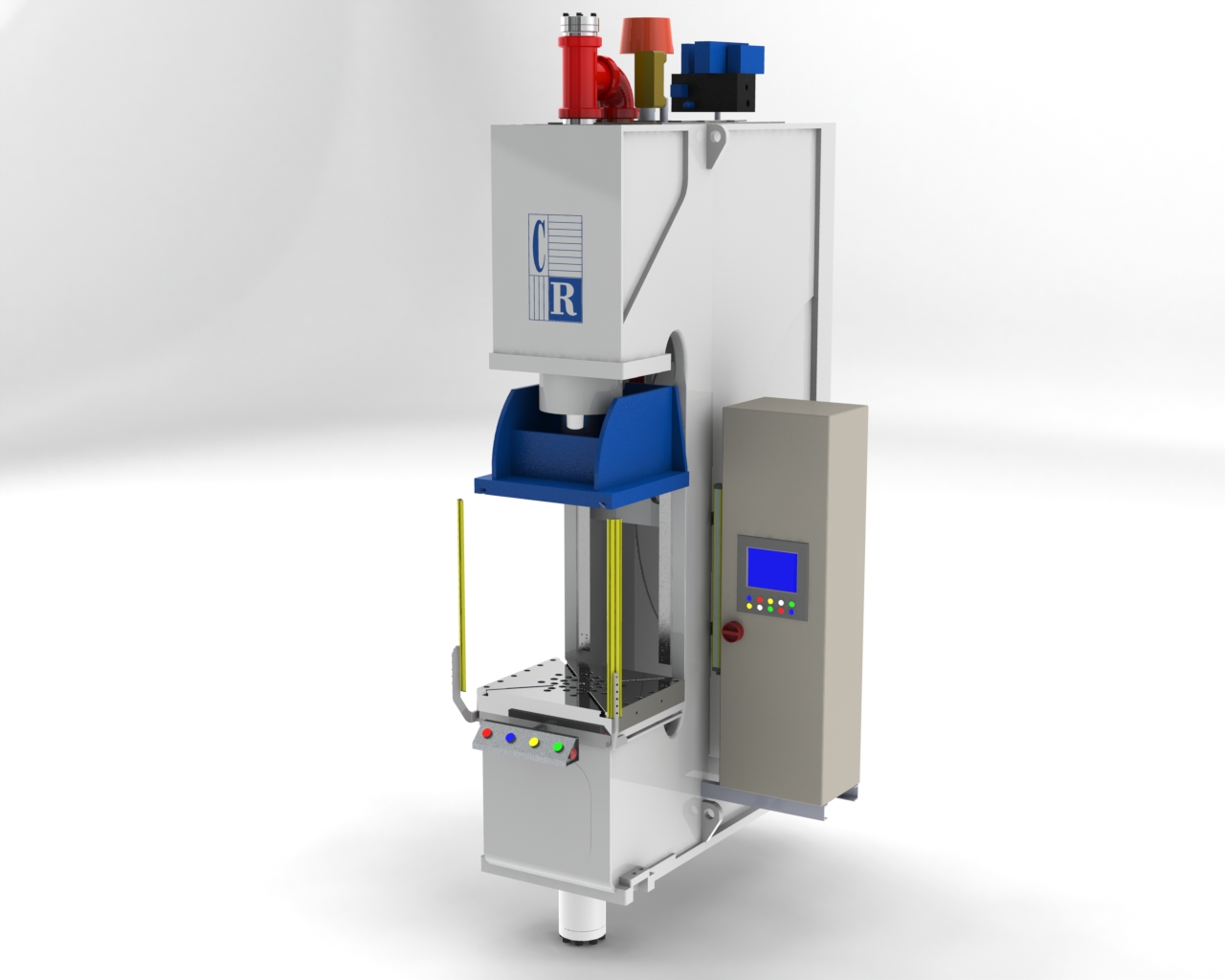
Swan neck or "C" structure
This type of structure is used for small and medium presses. The characteristic structure of these presses with three open working sides allows for easy manual loading and unloading of the workpieces to be produced. However, the structure, in addition to undergoing elastic elongation deformation, is subjected to a bending stress under load which leads to errors in parallelism and coaxiality of the forming tools, with the consequent reduction in the operating life of the tools themselves.
They are therefore characterized by a greater versatility, but they “open up” under load increasing the parallelism error as the workforce grows. For this reason, they are, in general, more suitable for light production and with lower requirements for precision of the pieces. It should also be considered that with the introduction of European safety regulations, all working sides of the press must be carefully protected; this could limit the accessibility of the press in some configurations.
With the structure defined, the second parameter that affects the press capacity is the number of push points.
Thrust Points: How the Work Area Determines Cylinder Configuration
The choice of thrust points and therefore the number of cylinders used in a hydraulic press is essentially dictated by the area of the press worktops and the maximum achievable size of the cylinder bore.
Number of effects: the movement that defines the processing
The third criterion concerns the number of effects, i.e. the independent working movements with which the press is equipped. A variable that directly determines the type of processing that can be performed.
Simple effect
The press is equipped with only one working movement, usually from top to bottom. Typically presses for assembly, compaction, forging and blanking.
Double effect with passive cushion
The press is equipped with an upper work surface that has the function of a drawing effect and a lower reaction surface that has the function of a sheet metal or cushion. In the upper plane there may be one or more cylinders with the function of extracting the pieces. Typically drawing presses with traditional system.
Double effect with active cushion
The press features two upper worktops inside each other. The outer surface acts as a blank holder, while the inner surface acts as a funnel. There may be a lower effect with extractor function or additional cushion.
Depending on the particular to be produced and the technological sequence to be adopted, multiple combinations of the effects described are also possible.
Structure, push points, number of effects: three variables that, when combined, define a machine. Knowing them is the starting point. The next question is how to use them to make an informed purchasing decision.
Each press is the result of precise design choices. In future insights, we’ll go into detail about those choices: the selection criteria that rarely appear in datasheets and that determine the machine’s actual performance over time.